
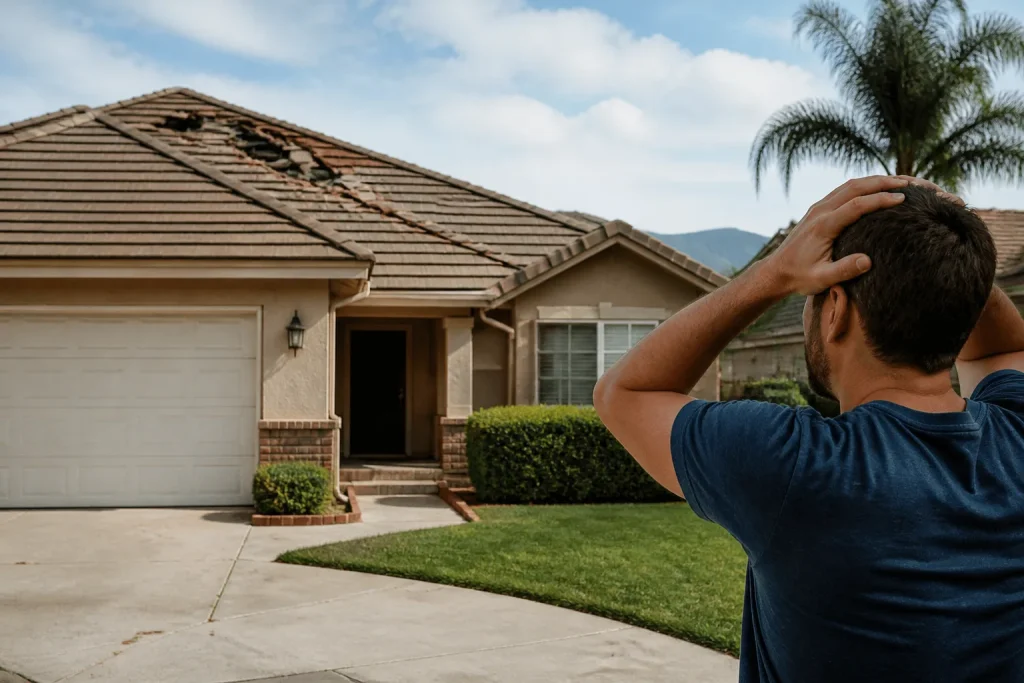
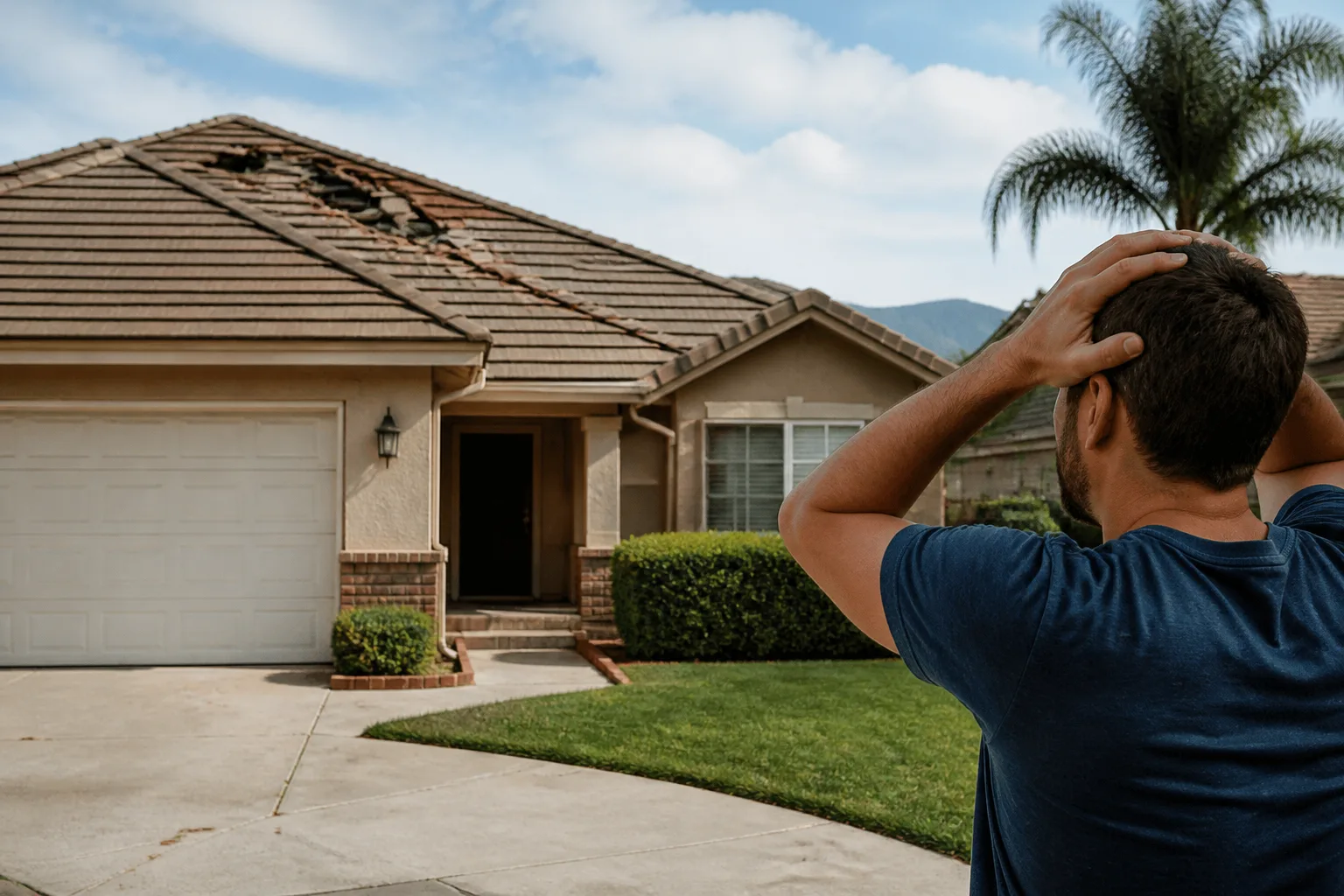
Emergency Roof Repair Near Me: What Fontana Homeowners Should Do First
If you’ve just discovered a leak, missing shingles, or storm damage, the first thing to do is stop water from getting in. Move anything of value out of the way, place buckets or towels under active leaks, and photograph everything from multiple angles before you touch anything else. Then call a Fontana roofing contractor who does repairs as a core service, not a replacement upsell. If you’d rather not handle any of this yourself, call Barnwood Roofing at (855) 382-1073 and we’ll walk you through it over the phone.
Your homeowner’s insurance adjuster will ask whether you took “reasonable steps” to prevent further damage after a storm. Most Fontana homeowners don’t know what that phrase legally requires, and that’s where claims get denied. This guide covers exactly what to do in the first 30 minutes, what to document, when to stay off the roof, and how to avoid the storm chasers who show up uninvited after every Santa Ana wind event.
What to Do in the First 30 Minutes After You Spot Roof Damage
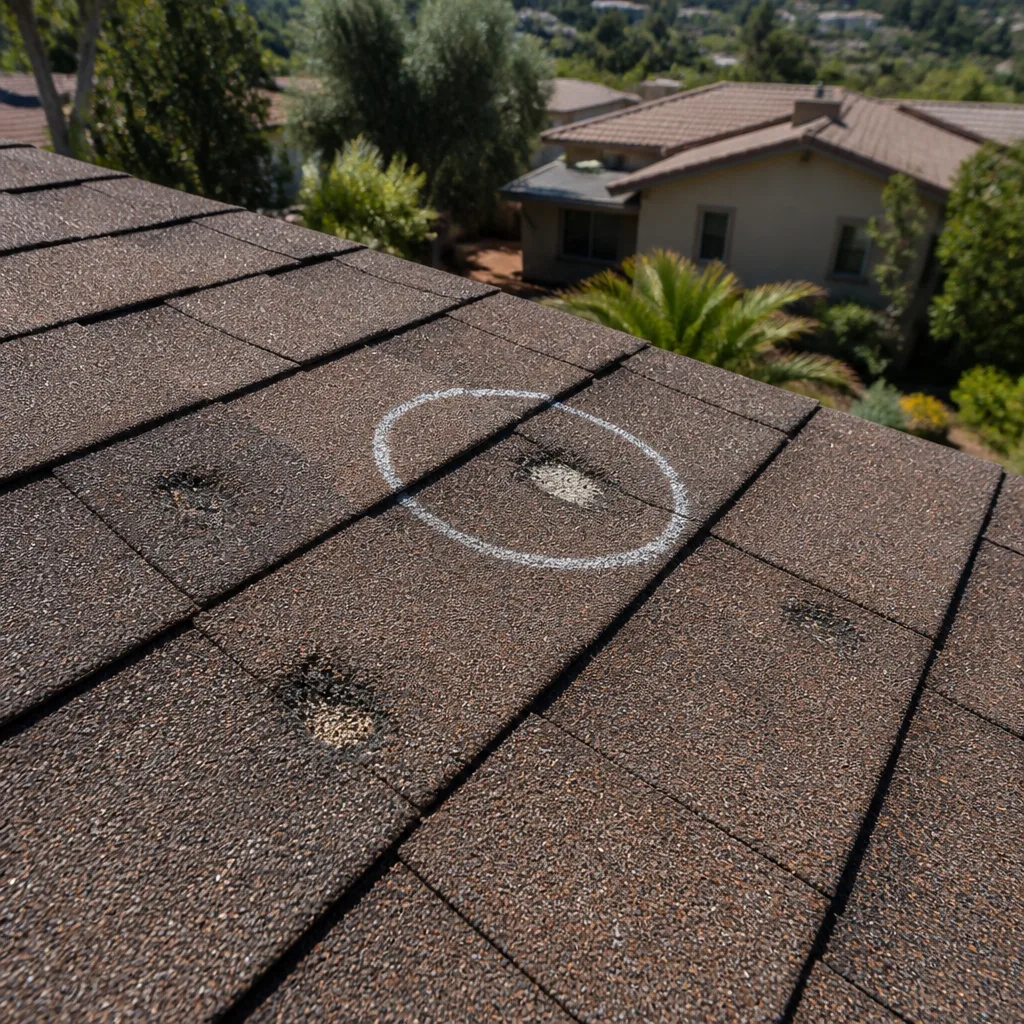
The half hour after you notice damage matters more than the hours it takes a contractor to arrive. Water moves fast, and drywall, insulation, and flooring don’t forgive. Here’s the sequence we recommend to every Fontana homeowner who calls us in a panic:
- Contain the water inside first. Move furniture, electronics, and anything porous out of the path. Place buckets under active drips. If water is pooling in the ceiling, poke a small hole with a screwdriver to release the weight. The hole gives the water a controlled exit and can prevent a larger ceiling collapse. It sounds counterintuitive, but a small hole drywall patch is far cheaper than a new ceiling section.
- Document before you disturb. Photograph everything: the interior stains, the water path, the exterior damage you can see from the ground. Your phone’s timestamp is your paper trail. Do this before moving soaked boxes or wiping up water, because insurance adjusters want to see the damage as it happened, not after cleanup.
- Check for immediate hazards. If water is near electrical fixtures, flip the relevant breaker. If a tree branch is against the roof, don’t try to remove it yourself if it’s entangled with power lines. Fontana’s older neighborhoods, particularly parts of downtown and the areas off Sierra Avenue, have mature trees that drop limbs in high wind. Assume every downed line is live.
- Call your insurance company. Most policies require prompt notification. Tell them you’ve taken emergency mitigation steps and ask what “reasonable steps” means under your specific policy. Write down the name of the person you spoke with and the claim number they assign. That conversation is the start of your paper trail.
We’ve walked Fontana homeowners through this sequence more times than we can count. The people who follow steps one through three before calling us end up with smaller repairs and smoother claims. The people who skip straight to calling roofers end up with a bigger mess on their hands, both in the house and in the file with their insurer.
What Constitutes “Reasonable Mitigation” Under California Homeowner Policies
Standard California homeowner policies include a clause requiring you to protect your property from further damage after a loss. The phrase you’ll hear is “reasonable steps to mitigate.” What that means in practice: if a section of your roof is exposing the interior to rain, and you don’t cover it, your insurer can argue that the water damage that followed was avoidable and therefore not fully covered.
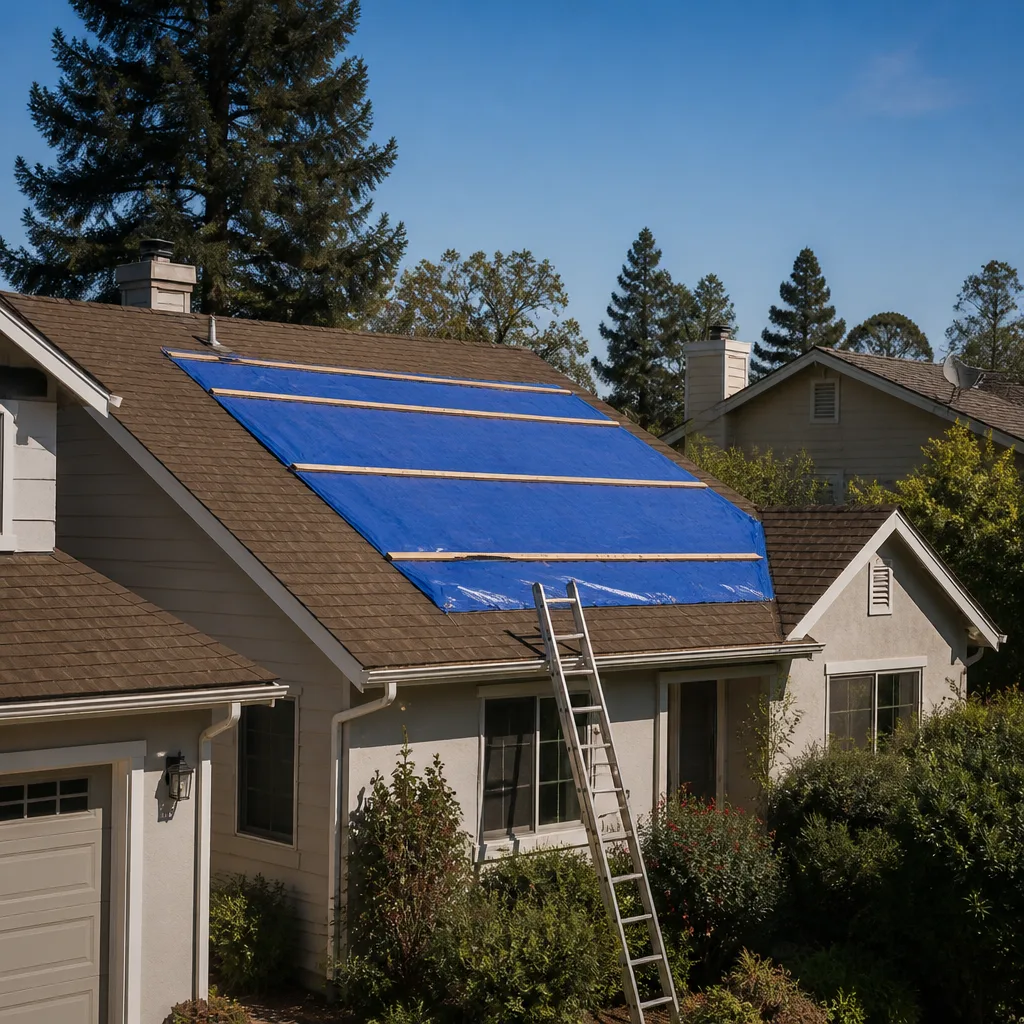
In Fontana, where we get concentrated winter storms and the occasional summer monsoonal moisture push, the most common scenario is wind-driven rain entering through a lifted shingle or a compromised roof penetration. The mitigation step an adjuster wants to see is a temporary cover, most often a tarp or heavy plastic sheeting, secured over the damaged area.
What the adjuster doesn’t expect is a professional repair within 24 hours. That’s rarely possible after a major storm. They want evidence that you tried. A tarp held down with sandbags or bungee cords, installed the same day or first thing the next morning, is almost always sufficient. Photograph the tarp after it’s in place, and keep the receipt for materials. That’s your proof.
Where this gets tricky is when the damage is high up on a two-story roof, or the weather is still dangerous. “Reasonable” doesn’t mean reckless. If getting on the roof would put you at risk, document why you waited, whether that’s a screenshot of the wind advisory or photos of the roof condition. Your safety argument holds up if you can show the conditions made DIY mitigation unreasonable.
Ground-Level Tarping vs. Getting on the Roof: How to Decide Safely
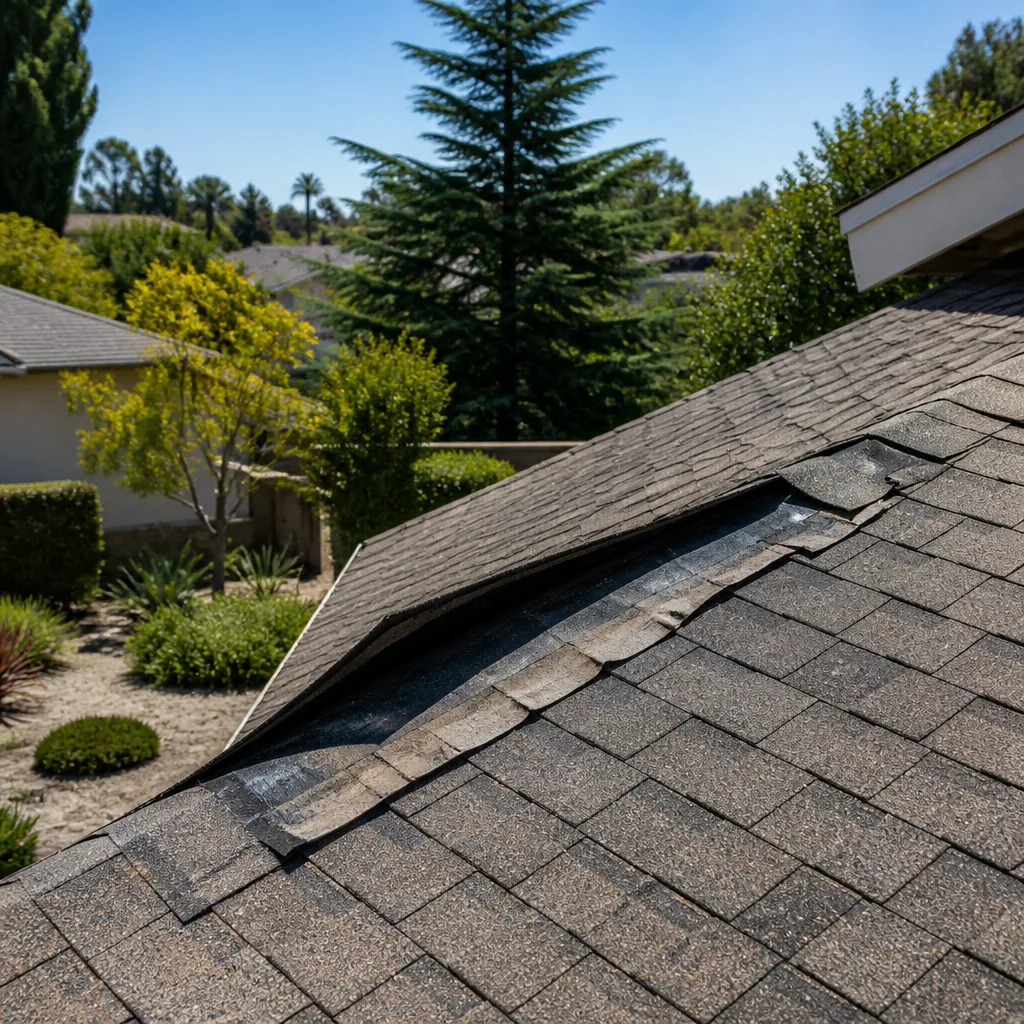
Here’s the honest version: most emergency roof covering in Fontana does not need to happen from on top of the roof. But there is a right way and a wrong way to do it from the ground, and the difference shows up when the adjuster reviews your photos.
Tarp from the ground when: the damaged area is near the roof edge, or you have a single-story roof with a low slope. In these cases, you can slide a tarp up from a ladder placed at the eave, or use a weighted ridge method that drags the tarp over the affected area without you ever standing on the roof surface. The key is securing the tarp’s edges with materials heavy enough to resist Santa Ana wind gusts. Sandbags are best. Bricks and concrete blocks work. Loose 2x4s don’t, especially not in Fontana where south-facing slopes catch the worst of the afternoon winds off the Jurupa Hills.
Stay off the roof entirely when: it’s wet, the pitch is steep, you’re dealing with two stories, or the damage is more than eight feet from the eave. Post-Santa Ana wind damage is particularly dangerous because the damage pattern is often loose fasteners and shifted tiles that look intact but give way under weight. One misplaced step and you’ve turned a $600 repair into a hospital visit and a much larger claim. This is exactly when to call us. We’ve pulled tarps off Fontana homes where the homeowner’s attempted fix had three corners flapping loose and the damage had doubled since the first photo. Good intentions, bad outcome.
Storm Chasers in the Inland Empire: How to Spot Them
Every time a significant weather event hits Fontana, the door-knockers appear. They claim they were “in the neighborhood” and noticed your roof “looks damaged.” Some of them are legitimate local companies running storm lead programs. Many of them are not. The difference matters because the bad ones write contracts with production dates that never happen, take deposits and disappear, or do work that fails the next season’s wind test.
Here’s what the transient operators do differently. They solicit door to door, unsolicited, in the days immediately following a storm. They offer to “work directly with your insurance” but want you to sign an assignment of benefits that hands them the claim. They push for a full replacement before anyone has put eyes on the actual decking. They don’t have a Fontana or Inland Empire address on their paperwork, or the address is a P.O. box. They use high-pressure language and a “today only” discount that evaporates if you ask for time to think.
Legitimate Fontana roofing contractors don’t need to pressure you. If a roofer tells us or anyone else that a repair is enough, they’re working for the home, not the invoice. The post-storm solicitation itself isn’t the red flag. The red flags are the pressure, the vague paperwork, the local references that don’t check out, and the refusal to give you a written line-item estimate. Before you sign anything, take a breath and a cup of coffee. The damage isn’t getting worse in the time it takes to make one phone call.
Related services in Fontana: Roof Repair in Fontana for storm damage that needs a pro, Roof Inspection in Fontana if you’re not sure whether you even have damage, and Roof Replacement in Fontana if the storm revealed that your roof was already near the end.
What Information to Have Ready When You Call a Roofer in Fontana
When you call us after a storm, the first three minutes of the conversation determine how fast we can help. Having a few things ready makes the difference between a same-week repair and a same-day one. Here’s what to write down before you dial:
- The approximate location of the damage. North, south, east, or west slope? Near the chimney, a vent pipe, a skylight, a valley? The more specific, the better. This tells us which crew to send and what materials to load.
- What you saw or heard. A wet spot on the vaulted ceiling, granules in the gutter, a shingle in the backyard, a branch resting on the roofline. Each one points to a different repair.
- The age of your roof, if you know it. This helps us triage: an 8-year-old roof with a leak around a pipe boot is probably a penetration failure. A 30-year-old roof with the same leak might need a different discussion.
- Your insurance situation. Have you already filed a claim? Do you plan to? This shapes how we document the repair and what we recommend for materials.
- Photos ready to text or email. Three or four clear shots from the ground, plus interior photos if water got in. It saves a trip and helps us bring the right ladder, the right sealant, and enough replacement material.
We don’t need you to know roofing terminology. “The part above the garage near the gutter” works. What helps is knowing which side of the house and roughly how far from the edge. In Fontana, where summer heat bakes south-facing slopes and Santa Anas hit the same slopes hard in the fall, the damage pattern often tells us the story before we see it.
Should You File an Insurance Claim for a Small Roof Leak?
Here’s the answer most Fontana homeowners don’t hear: a small leak around a vent pipe or a few missing shingles usually doesn’t justify an insurance claim. Your deductible likely sits somewhere between $1,000 and $2,500, and a repair in that range, which we do regularly, costs less than the deductible plus the premium increase you’ll see after filing.
The calculation changes when the storm caused widespread damage. If you’ve got lifted shingles across multiple roof slopes, water in more than one room, or a tree fell on the house, file the claim. The rule of thumb is simple: is the repair cost meaningfully higher than your deductible? If yes, file. If no, pay out of pocket and keep your claims history clean.
One more consideration: California insurers have grown picky in recent years. A single storm claim might not hurt you much. Two or three small claims in five years can get you non-renewed. If you file and your insurer sends an adjuster who determines the damage wasn’t from a covered peril, that’s still a claim on your record. Get the scope of the damage clear before you call your insurer, which is exactly what a Roof Inspection in Fontana from us gives you: a clear, documented assessment you can hand to the adjuster or keep in your own file.
Why the First Call Usually Isn’t the Roofer
Most homeowners pick up the phone and start dialing roofing companies the minute they see water on the ceiling. We understand the instinct. But the first call should almost always be to your insurance agent, and the second to a roofer. Here’s the sequence that protects your interests:
- Call your insurer first. Start the claim, get the claim number, ask what mitigation they expect. This takes ten minutes and anchors the paper trail.
- Call the roofer second. Now you can tell us the claim status, which changes how we scope and document the repair.
- Get the temporary cover in place. If you’re comfortable doing it from the ground, do it. If not, tell us when you call and we’ll get a tarp crew out as part of the repair visit.
The order matters less than the documentation. What the adjuster looks for is a coherent story: the damage happened, you took reasonable steps to stop it getting worse, you got a qualified professional assessment, and you made the repair with materials appropriate to the home. Skipping steps creates gaps, and gaps create reasons to deny coverage.
When to Call a Pro Instead of Handling It Yourself
Some Fontana homeowners are genuinely handy and want to tarp their own roof. If the pitch is low, the damage is near the edge, and the weather is calm, that’s a reasonable job. But there are clear lines where DIY stops being sensible:
- Water is already inside the house. Interior water means the roof system has been compromised past the surface. You need a professional assessment, not a tarp.
- The damage is on a two-story section. Falls from height are the leading cause of roofing-related emergency room visits. No repair is worth that.
- The roof is steep or tile construction. Concrete tile and clay tile Fontana roofs are heavy, slick when wet, and easy to crack underfoot. Walking on them without knowing how to distribute weight causes more damage than the storm did.
- You’re not sure what you’re looking at. A roofer’s eye tells a lot from the ground. We can often tell whether a stain is new, old, structural, or cosmetic without anyone going up a ladder.
In our experience, the cost of a professional assessment is almost always less than the cost of a botched DIY fix that a contractor then has to undo. And a Roof Inspection in Fontana is a standalone service we offer precisely for these situations: you get an honest read on what’s wrong, what it’ll take to fix, and whether you even need to do anything this year. No obligation to book a repair.
Key Takeaways
- The first 30 minutes after roof damage are for containment, documentation, and hazard checks, not just phone calls.
- Photograph everything before you move or clean anything, and keep your mitigation receipts.
- “Reasonable steps to mitigate” under California policies means a tarp or cover, not a full same-day repair.
- Tarp from the ground when possible. Stay off steep, wet, or two-story roofs.
- Unsolicited door-knockers after a storm are often storm chasers; ask for a local address and written line-item estimate.
- Small leaks often cost less than your deductible plus future premium increases. Get the scope clear before you file.
The Bottom Line
Roof damage in Fontana is manageable when you act in the right order: contain, document, call your insurer, call a roofer, cover the exposed area safely, and choose a contractor who has no financial reason to push a replacement when a repair will do. The storm chasers counting on your panic are counting on you skipping the documentation and signing fast. Don’t give them that opening.
If you’re in Fontana and you’re looking at damage right now, or you just want a straight answer about what’s going on up there, call Barnwood Roofing at (855) 382-1073. We do repairs as a core service, not an afterthought, which means we’ll tell you if a repair is enough. Free estimates, no oversell, and we’ve been serving Fontana. We also carry materials from seven manufacturers including GAF, CertainTeed, and Tamko, which means the product recommendation fits your home and budget, not the warehouse.
Frequently Asked Questions
Emergency roof repair in Fontana typically runs between $350 and $900 for common storm damage like lifted shingles, small leaks, or a missing section of tile. Larger repairs involving decking or multiple slopes cost more. The only way to know is an inspection. Call (855) 382-1073 for a free estimate, and we’ll give you a written line-item scope before any work starts.
Yes, if the damage is from a covered peril like wind or falling debris and the repair cost exceeds your deductible. Document everything, call your insurer promptly, and take mitigation steps. If the repair is smaller than your deductible, paying out of pocket is usually the smarter financial move. Call (855) 382-1073 if you need help figuring out which path makes sense.
A properly secured tarp can stay in place for several weeks, though it’s not a permanent fix. Fontana’s Santa Ana winds test weak tie-downs quickly, so if you tarp your own roof, check it after every wind event. If you’d rather have it done right, call (855) 382-1073 and we’ll handle the temporary cover as part of the repair.
Yes. We respond to storm damage, active leaks, and other urgent roof issues throughout Fontana. Call (855) 382-1073 and have ready: the damage location, what you observed, your roof’s approximate age, whether you’ve filed a claim, and photos if you have them. That helps us bring the right crew and materials on the first trip.
Written by the team at Barnwood Roofing, serving Fontana.
Need Roofing Help?
Call Barnwood Roofing - licensed & insured, here with fast help in Fontana.
(855) 382-1073